Monday, April 13, 2009

This Bird has flown

Another chunk of my childhood passed away today.

Mark "The Bird" Fidrych has died this afternoon in an apparent accident, at the age of 54.

Fidrych was the wunderkind Detroit Tigers pitcher who took baseball by storm in the summer of 1976. Fidrych — nicknamed "The Bird" because of his striking resemblance to Big Bird, the towering Muppet from Sesame Street — became a household name as much for his antics on the mound as for his prodigious pitching prowess.

A frenetic bundle of nervous energy, Fidrych talked aloud to himself — and occasionally, to the baseball — while pitching. He would kneel on the mound between pitches and groom the dirt with his hands. He'd run over to his teammates and congratulate them with high-fives for making successful infield plays. His infectious enthusiasm made The Bird an overnight superstar.

After starting the year with a 7-1 record, the rookie phenom received the starting assignment for the American League in the 1976 All-Star Game. Fidrych finished the season with a 19-9 record and a 2.34 earned run average. Named the American League Rookie of the Year, he also came in second in the voting for the Cy Young Award.

He was never the same again.

Plagued by injuries beginning in his sophomore campaign, Fidrych would pitch sporadically with the Tigers over the next four seasons. He won only 10 more games after that legendary rookie year. He pitched his last game for the Tigers in 1980, and when Detroit released him at the end of the 1981 season, The Bird was out of the game.

He attempted an unsuccessful minor-league comeback in the Boston Red Sox organization in 1983, but he never got back to The Show.

I had the privilege of seeing The Bird best the Oakland Athletics in a game at the Coliseum during that shining Bicentennial summer. That memory remains one of my all-time favorite baseball moments.

Mark "The Bird" Fidrych was truly one of a kind.

Labels: , , ,

Super freak

I'm not sure why I'd be surprised by this revelation, but...

According to a recently published book by comics historian Craig Yoe, Joe Shuster — the artist half of the creative team who dreamed up Superman — spent a portion of his career in the 1950s drawing sadomasochistic fetish comics featuring characters who look suspiciously like Clark Kent and Lois Lane.

Apparently, it wasn't only kryptonite that made the Man of Steel weak in the knees. Whips and chains did the trick as well.

Yoe's book Secret Identity uncovers (no pun intended) the lurid art Shuster drew for an underground magazine entitled Nights of Horror. An article in USA Today quotes Yoe's observation:
Joe obviously had some very dark fantasies. There's a panel in an early Superman comic book where he has Lois over his knee and is spanking her. But certainly nothing of this depth or extremeness.
As I said, this really doesn't shock me. Plenty of artists from mainstream comics sidelined in erotica, especially back in the days when mainstream comics habitually paid their creators in chicken feed and shoeshines.

To cite a few examples:
  • Wally Wood — one of comics' most talented artists ever, in my (and many other knowledgeable people's) opinion — was a one-man cottage porn industry in his later years.
  • Will Elder, one of the artists who helped make MAD Magazine a household name, drew Little Annie Fanny for Playboy for more than a quarter-century.
  • Bill Ward, who started his career drawing Captain Marvel and Blackhawk before creating the classic "good girl" character Torchy, cranked out hundreds of sexy strips for men's magazines.
  • Adam Hughes, perhaps comics' preeminent present-day "good girl" artist, used to freelance for Penthouse.
I'm sure, though, that more than a few folks will find the blood draining from their faces when they see Superman (or a guy who could be his identical twin brother) letting his freak flag fly.

Great Caesar's ghost, indeed.

Labels: , , ,

Thursday, April 09, 2009

Fallen Angel

It's a gray and gloomy day for baseball here in the Golden State.

Appropriate, given the tragic news about the death of Los Angeles Angels pitcher Nick Adenhart, killed last night in a hit-and-run accident caused by a suspected drunken driver.

Less than 24 hours ago, 22-year-old Adenhart had the world on a string. In his fourth major league start, he pitched six innings of shutout ball against the Oakland Athletics.

Today, he's gone.

I'll say here what I've said numerous times before: There is no punishment severe enough for drunk driving.

I believe that driving under the influence should receive mandatory prison time. No probation. No suspended license. No enforced rehab. No 36 hours in the county slammer. A minimum of one year hard time in the state penitentiary. No plea bargains, no questions asked.

Second-time offenders should be sentenced to a minimum of five years. Third-timers get twenty.

Drunk drivers who kill? Automatic life sentence.

And if someone wanted to argue for making the latter a capital crime, they'd get no protest from me.

Andrew Gallo, the knucklehead who snuffed out the lives of Nick Adenhart and his two friends, Henry Pearson and Courtney Stewart — and who was himself uninjured in the crash — was driving under a suspended license due to a prior drunk driving conviction. If Gallo had been in San Quentin where he belonged — in my opinion, if not the State of California's — three young people with bright futures would be alive today.

My sincere condolences, as well as my deepest empathy as a father, go out to the families of the deceased.

I bear-hugged my daughter when she came home from her college classes today. She thought I was crazy. Perhaps I am.

But life is fragile.

Even when you're 22 years old, and have a million-dollar arm.

Labels: , , , ,

Friday, March 27, 2009

Ye gods!

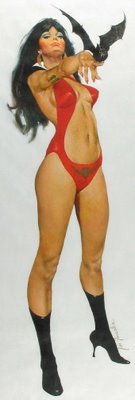
Today's Comic Art Friday is dedicated to the memory of comics artist José Gonzalez — known to his legions of fans as "Pepe" — who passed away on March 17 at the age of 70.


Acclaimed as a legend in his native Spain, Gonzalez was best known on these shores for his early 1970s work on the Warren Publishing title Vampirella. Such preeminent talents as Frank Frazetta (who painted the very first Vampirella cover) and Joe Jusko have hailed Gonzalez as one of comics' greatest illustrators.

You will be sadly and deeply missed, Pepe.

As demonstrated by Pepe Gonzalez, the highest honor that any artist can achieve is the admiration of his or her fellow artists. In any field, the talents most revered are those whose greatest fans are their peers. I'm fortunate to have in my comic art collection a handful of pieces by artists who've reached that level of accolade — such legends as Tony DeZuniga, Alex Niño, Adam Hughes, and the late Mike Wieringo, to mention just a few.

To mention just one more...


Steve "The Dude" Rude.

Perhaps most famed as the co-creator (with writer Mike Baron) of Nexus, one of the seminal superhero comics of the 1980s, Rude has the well-earned reputation of "artists' artist." His style reflects the vision of two of the medium's most influential geniuses, Jack Kirby and Alex Toth, but merges those precedents with original flair and modern sensibility. In today's comics world, no one's art looks quite like Steve Rude's.

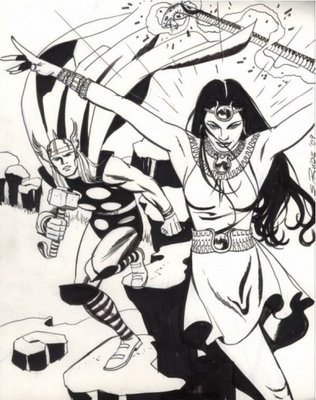
I dreamed up the Common Elements pairing shown above — the mighty Thor and the mighty Isis — specifically with Rude in mind to draw it. To be honest, I never thought that would happen. Rude accepts commissions infrequently, and is known to be selective about the subject matter in those he does take on. (He doesn't like to draw Batman or Green Lantern, for example, even though I can think of few superheroes better suited to his approach than those two.) When opportunity presented itself to add a Rude to my Common Elements gallery, I suggested this, and hoped for the best.

And the best is precisely what The Dude delivered.

My fascination with Isis, star of that pinnacle of '70s Saturday mornings, The Secrets of Isis, has been extensively documented in this space. Although I own an attractive gallery of Isis commissions, this is the Mighty One's Common Elements debut.

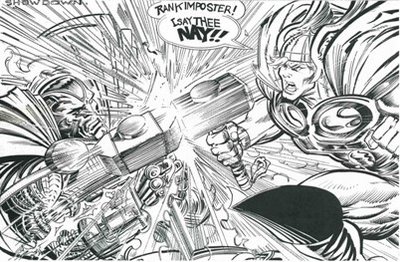
Thor makes his second Common Elements appearance here. Previously, the God of Thunder squared off with John Henry Irons — better known as Steel — in one of the earliest entries in the series: "Showdown," penciled by the inimitable Trevor Von Eeden and inked by the dependable Joe Rubinstein.


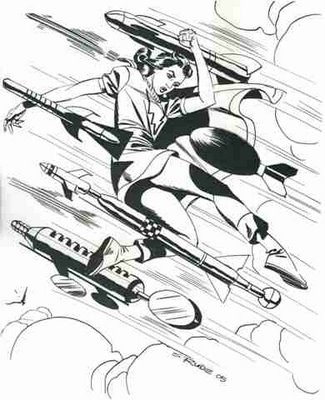
Although this Isis-meets-Thor spectacular is Steve Rude's first shot at Common Elements (one would hope that it won't be his last), it marks the second occasion on which he's drawn a commission for me. Several years back, Rude created one of the highlights of my Mary Marvel gallery — this bombastic pinup in which the World's Mightiest Maiden artfully dodges a plethora of ominous-looking projectiles.


And that's your Comic Art Friday.

Labels: ,

Monday, January 19, 2009

Dr. King on the power of love

Dr. Martin Luther King, Jr., addressing the Southern Christian Leadership Conference in Atlanta, August 16, 1967:
It is perfectly clear that a violent revolution on the part of American blacks would find no sympathy and support from the white population and very little from the majority of the Negroes themselves. This is no time for romantic illusions and empty philosophical debates about freedom. This is a time for action. What is needed is a strategy for change, a tactical program that will bring the Negro into the mainstream of American life as quickly as possible. So far, this has only been offered by the nonviolent movement. Without recognizing this we will end up with solutions that don't solve, answers that don't answer and explanations that don't explain.

And so I say to you today that I still stand by nonviolence. And I am still convinced that it is the most potent weapon available to the Negro in his struggle for justice in this country. And the other thing is that I am concerned about a better world. I'm concerned about justice. I'm concerned about brotherhood. I'm concerned about truth. And when one is concerned about these, he can never advocate violence. For through violence you may murder a murderer but you can't murder. Through violence you may murder a liar but you can't establish truth. Through violence you may murder a hater, but you can't murder hate. Darkness cannot put out darkness. Only light can do that.

And I say to you, I have also decided to stick to love. For I know that love is ultimately the only answer to mankind's problems. And I'm going to talk about it everywhere I go. I know it isn't popular to talk about it in some circles today. I'm not talking about emotional bosh when I talk about love, I'm talking about a strong, demanding love.

And I have seen too much hate. I've seen too much hate on the faces of sheriffs in the South. I've seen hate on the faces of too many Klansmen and too many White Citizens Councilors in the South to want to hate myself, because every time I see it, I know that it does something to their faces and their personalities and I say to myself that hate is too great a burden to bear.

I have decided to love. If you are seeking the highest good, I think you can find it through love. And the beautiful thing is that we are moving against wrong when we do it, because John was right, God is love. He who hates does not know God, but he who has love has the key that unlocks the door to the meaning of ultimate reality.
Thanks for the reminder, Dr. King. I wish only that you could be there in Washington tomorrow, to see in shining measure what you and so many others made possible.

Speaking of love...

Happy 24th anniversary, KJ!

Labels: , , ,

Wednesday, January 14, 2009

Does this casket come with soft Corinthian leather?

Wow, bad day for aged celebrities.

No sooner did I complete my obit of Patrick McGoohan than word arrives of the passing of Ricardo Montalbán, who, depending on your viewing preferences, was either Khan Noonien Singh of the classic Star Trek episode "Space Seed" and its sequel motion picture, Star Trek II: The Wrath of Khan, or the dapper Mr. Roarke, the ice-cream-suited master manipulator of Fantasy Island.

We children of the '70s, of course, also recall Montalbán as the suave pitchman for the Chrysler Cordoba, famously upholstered in "soft Corinthian leather." The joke was that "Corinthian leather" was little more than some copywriter's snazzy buzzword for a product manufactured in Newark, New Jersey.

I often thought that Mr. Roarke had the most depressing job in the world. He spent all of his time and resources creating fantasies for other people — fantasies which never seemed to work out all that well for the recipients. Then, he'd cluck his tongue at the hard lessons learned when people got what they thought they wanted. Roarke was like a sadistic Santa Claus, albeit with bespoke tailoring and better weather.

To top it off, Mr. Roarke never seemed to get any of his own fantasies fulfilled. Unless his fantasies involved living on a tropical island with a lisping French dwarf. In which case, I guess he did.

My favorite episode of Fantasy Island was the one in which Mr. Roarke faced off with the devil (who, oddly enough, did not resemble Al Pacino) and emerged victorious. That storyline opened up a whole new realm of possibilities for Roarke, who prior to this had just seemed like a wealthier, more inventive Walt Disney. Was he really an angel? A sorcerer? A Highlander? (There can only be one, so probably not.)

Then again, the devil did tell Roarke at the end of the episode that he'd be back to fight again another day.

Perhaps that day was today.

Labels: , , ,

Be seeing you, Number Six

Don't tell Number Two, but Number Six has escaped.

Permanently.

Patrick McGoohan, a hero to a generation of genre TV cultists as the star of the classic espionage series Danger Man (retitled Secret Agent for American broadcast on CBS) and its even more famous "sequel" The Prisoner, has died at the age of 80.

For those of you who missed the 1960s, The Prisoner starred McGoohan (who cocreated the show with producer George Markstein) as a spy who, after submitting his resignation, is kidnapped and transported to an isolated seaside community known only as The Village. The protagonist, whose real name is never divulged, is referred to as Number Six. (Most fans suppose Number Six to be John Drake, the hero of Danger Man, even though McGoohan consistently denied this — most likely because someone else owned the rights to the earlier character.) Indeed, all residents of The Village are known only by numeric designations, including the sinister head honcho, Number Two (played by a different actor in almost every episode).

The 17-episode series revolves around Number Six's ongoing efforts to either escape — efforts often thwarted by an enormous, seemingly sentient balloon called Rover — or subvert Number Two's authority and control of The Village, or both. Number Two, in turn, engages in a constant stream of cat-and-mouse mind games, trying to learn why Number Six resigned his post (and, by implication, for whom Six might have been working).

In a memorable two-part finale, Number Six finally manages to break free of The Village's confines. Or does he?

I'm a member of that hardcore band of pop culture geeks who maintain that The Prisoner is one of the greatest series ever created for television. It's smartly written, thought-provoking, and can be interpreted in a variety of ways, depending upon one's political perspective and psychosocial worldview. Its 17 episodes span a broad range of genres — mystery, action-suspense, comic satire, even Western (the episode "Living in Harmony").

Thanks in large part to McGoohan's rigid control, the show maintained a high quality level, even though it ran longer than McGoohan originally proposed. (CBS insisted on 17 episodes, to ensure an afterlife in syndication — McGoohan conceived the show as a seven-episode cycle.) The Prisoner frequently explored themes that were considered controversial for the time: conspiracy theories, government mind control, propaganda, psychedelic drugs, anti-authority rebellion, and anti-war sentiment.

When I was studying broadcast communications at San Francisco State University, I took a course in semiotics — the study of symbols and signs as facets of the communication process — taught by one of the world's leading experts in the field, Dr. Arthur Asa Berger. Episodes of The Prisoner were among Dr. Berger's favorite teaching tools.

Ironically, Patrick McGoohan's passing comes shortly before the debut of a modernized retelling of The Prisoner, which airs later this year on American Movie Classics. The new Prisoner stars Jim Caviezel as Number Six, and Ian McKellen as his adversary, Number Two.

McGoohan continued to be much sought after as a character actor for decades following The Prisoner. He gained critical acclaim as the villainous King Edward, a.k.a. Longshanks, in Mel Gibson's Braveheart, and as the father of Billy Zane's jungle superhero in The Phantom. My favorites among his post-Prisoner roles were his frequent turns as perpetrator on Columbo (McGoohan won two Emmy Awards for his Columbo appearances, several of which he also directed), and his starring turn in the short-lived 1970s medical series Rafferty, which foreshadowed House by about 25 years.

Despite his impressive body of work, McGoohan will always be Number Six in my imagination.

"I am not a number — I am a free man!"

Labels: , , , ,

Thursday, January 08, 2009

There's a new zombie in town

I'm not an especially sentimental sort — as regular visitors here will attest — but it makes me sad to see the icons of my youth fade from view.

Just moments ago, I received an e-mail announcing the passing of Bob Wilkins, the longtime host of KTVU's Creature Features. I spent many Friday and Saturday nights in the 1970s and early '80s enjoying cheesy horror and sci-fi flicks with the urbane, bespectacled Mr. Wilkins and his eventual successor in the host's rocking chair, John Stanley.

More than four years ago, I waxed nostalgic in this space about Creature Features and its profound impact on my adolescent years. Rather than reinventing the torture wheel, I'll simply invite you to check out that Halloween 2004 post.

I was privileged to meet Bob Wilkins in person a few years ago, when he made what I believe was his final guest appearance at WonderCon. Bob was obviously in ill health at that time, so I was glad that I took the opportunity to express to him my thanks for all the hours of entertainment. I'm even more glad now.

Keep that coffin lid tightly closed, Bob. You never know what might be trying to get in.

Or out.

Labels: , , , , , ,

Thursday, January 01, 2009

The Westlake postscript

Well, this was a sad way to end a year...

Donald E. Westlake
, one of the great mystery novelists of our time, died yesterday.

Westlake was a prolific creator who wrote in a variety of styles, from the comic caper novels he wrote under his own name, including The Hot Rock (adapted into a 1972 film starring Robert Redford), to the gritty crime novels he wrote under the nom de plume Richard Stark, most featuring the brutal criminal mastermind known only as Parker. Westlake's first Stark/Parker novel, The Hunter, was filmed twice: as Point Blank (with Lee Marvin) in 1967, and as Payback (with Mel Gibson) in 1999.

My favorite Westlake books were a series of mysteries he wrote in the late 1960s and early '70s, about a self-loathing former cop named Mitch Tobin. Mitch was a fascinating character — his partner was killed when Mitch failed to provide him backup during a bust, because at the time of the incident, Mitch was in bed with the partner's wife. Consumed by guilt and depression, Mitch withdrew from everyday life, occupying his time by building a useless brick wall in his back yard. On occasion, he would get dragged into some circumstance that compelled him to exercise his detective skills.

I believe the five Mitch Tobin books, which Westlake wrote using the pseudonym Tucker Coe — Kinds of Love, Kinds of Death; Murder Among Children; Wax Apple; A Jade in Aries; and Don't Lie to Me — have all been out of print for years. But if you stumble across one of them at a used bookstore, a garage sale, or your local library, and if you enjoy a good mystery featuring a dark yet quirky protagonist, I recommend them.

My favorite Westlake-as-Westlake book was his 1976 novel Dancing Aztecs. Like many of his stories, it's a crime caper wrapped in comedic trappings, featuring a gang of hapless crooks who can't seem to do anything right. The title refers to the book's McGuffin, a set of 16 identical statues, only one of which is the real (and valuable) McCoy. Another must-read, if you get the opportunity.

When he wasn't writing books at a phenomenal rate, Westlake also dabbled in screenplays. He received an Academy Award nomination for The Grifters, a terrific caper flick directed by Stephen Frears, the screenplay for which Westlake adapted from a Jim Thompson novel. Westlake also wrote the 1987 horror classic The Stepfather, which made a cult star out of Terry O'Quinn nearly two decades before Lost.

In addition, Westlake created the legendary TV flop Supertrain, which almost bankrupted NBC in the fall of 1979. But then, to quote the title of a 1977 Westlake novel, Nobody's Perfect.

Somewhere on my bookshelves I have an old book entitled Murder Ink, containing all manner of interesting trivia about mysteries and their authors. In that book, Westlake conducts a hilarious and informative interview as himself as well as three of his literary alter egos: Richard Stark, Tucker Coe, and Timothy J. Culver, under which name Westlake penned a political thrilled called Ex Officio. I'll have to dig that out and reread it in Westlake's honor.

Thanks for all the unforgettable stories, and especially those wonderful characters, Don. I'll miss you.

Labels: , , , ,

Monday, December 29, 2008

Frontier justice

I see on the news sites that Ellie Nesler died the other day.

If that name sounds vaguely familiar, it may help jog your memory if I point out that Ellie Nesler was the woman who in 1993 walked into a courtroom in the Gold Rush town of Sonora, California, and shot to death the man being tried for molesting her six-year-old son.

Ellie's initial conviction for voluntary manslaughter was overturned due to some jury shenanigans, but the pistol-packing mama later copped a plea and served three years in prison. Her sentence was actually longer than that, but she received a reduction because she was being treated for breast cancer. The whole episode was chronicled in a made-for-cable movie (USA Network, not Lifetime, but that shows you're thinking) in 1999.

The part of Ellie's story that didn't warrant a teleflick came in 2002, when she was convicted of selling methamphetamine and sent back to the slammer for another four years.

In 2004, while Ellie was cooling her heels at the women's prison in Chowchilla, her son William stomped a guy to death less than an hour after getting out of jail from a previous assault conviction. William is currently serving 25 years to life in the big house.

At the time of the incident that brought her national fame, Ellie Nesler was hailed by some as a heroine and vilified by others as a vigilante.

Now, we can just call her the late Ms. Nesler.

Labels: , , ,

Thursday, December 25, 2008

Catwoman's last groove

Not to rain a bummer down on your Yuletide or anything, but...

Eartha Kitt died today.

You young whippersnappers know Ms. Kitt as the voice of Yzma in The Emperor's New Groove, one of the best Disney animated films of the past decade, and its spin-off television series, The Emperor's New School.

Those of us with a few miles on our odometers knew that the multitalented Ms. Kitt possessed many facets. She was an actress; nominated for two Tony Awards, she was a favorite of actor-director Orson Welles (on and off the set, or so the whispers tell). She was a singer; ironically, given her death on Christmas Day, her best-known musical number was the original rendition of the pop-jazz carol "Santa Baby." She was a social activist; her scathing remarks condemning the Vietnam War at a White House function reportedly reduced Lady Bird Johnson, the then-incumbent First Lady, to tears.

Eartha Kitt broke barriers in a number of ways, perhaps most memorably in 1967, when she took over the role of Catwoman in the hit Batman after Julie Newmar left the show. "Color-blind" casting is relatively common today — think of Denzel Washington in the remake of The Manchurian Candidate, to cite just one recent instance — but in the '60s, it was practically unheard of that an African-American actor would be cast in a role written for a Caucasian.

Kitt's turn as the Felonious Feline was all the more remarkable in that the character's race was never made an issue. No one on Batman ever seemed to notice that the new Catwoman was black. Again, unheard of in mid-20th century Hollywood.

Kitt's tradition-shattering portrayal opened possibilities for countless other actors to be chosen for roles for which they might never have been considered — such as Halle Berry in the title role in Catwoman.

Umm...

Let me think of a better example.

How about Michael Clarke Duncan as the Kingpin in Daredevil?

Yeah, that works.

Back to Eartha Kitt...

In addition to her work behind the Disney microphone (for which she earned her second Daytime Emmy just a couple of months ago), the legendary star spent her later years performing her popular cabaret act, acting in the occasional stage production (she toured as the Fairy Godmother in the national company of Cinderella a few years back), and battling colon cancer.

She died less than one month shy of her 82nd birthday.

As the great Ms. Kitt might have said herself... meow.

Labels: , , , , , ,

Friday, December 19, 2008

Comic Art Friday: The Best of 2008

Today's Comic Art Friday is dedicated to the memory of Majel Barrett Roddenberry, the grande dame of the Star Trek universe, who passed away yesterday at the age of 76.

The widow of Trek creator Gene Roddenberry, Majel had a recurring role in the original 1960s series as Nurse Christine Chapel, whose most distinctive characteristic was her unrequited love for Mr. Spock. Majel also appeared as Lwaxana Troi, Deanna Troi's meddlesome mother, in Star Trek: The Next Generation and Star Trek: Deep Space Nine. Off camera, the actress provided the voice of the Enterprise's computer system in both the original series and ST:TNG, as well as that of the feline Lt. M'Ress in Star Trek: The Animated Series.

A beloved fixture for years on the convention circuit, Majel will be missed by Trek's legions of fans.


In addition to it being Comic Art Friday, today is my 47th birthday. So I'm going to do whatever I darn well please. (I know, I know... I do that every Friday. Old habits die hard.)

What pleases me is getting an early start on our traditional look back at the year's best acquisitions. This way, we can spread the retrospective goodness over two consecutive Comic Art Fridays, and bask in the reflected glow of my favorite new pieces of 2008 for a week longer.

In the words of the late Heath Ledger: And here... we... go!

Favorite "Common Elements" Commission, Heroes Division:
"Force of Gravity" — pencils by Sal Velluto, inks by Bob Almond
Captain Gravity and Gravity


Sal and Bob, the longtime artistic team on Marvel's Black Panther, created two incredible additions to my Common Elements theme gallery in 2008. I loved the whimsy of Sal's design in this one, which featured another character from the Sal and Bob catalog — Penny-Farthing's Captain Gravity.

Favorite "Common Elements" Commission, Heroines Division:
"Val to the Third Power" — pencils by Val Semeiks
Valkyrie (from Airboy) and Valkyrie (from The Defenders)


Val Semeiks's impeccable storytelling slams a home run with this concept, which was tailor-made (well, it would be, if I were a tailor) for him. Beautifully designed, and deftly drawn.

Favorite "Common Elements" Commission, Co-Ed Division (tie):
"Celestial Domes" — pencils by Steve Carr, inks by Joe Rubinstein
Moondragon and the Martian Manhunter


As was the case last year, I had a tough time deciding this category. Thus, for the second year in a row, I split the difference to honor two outstanding artworks. The early leader here was this dazzling scenario imagined by Steve Carr, then splendidly finished by Joe Rubinstein.

Favorite "Common Elements" Commission, Co-Ed Division (tie):
"Identity Theft" — pencils and inks by Mike Vosburg
Starfire and Steel


And then came this stellar entry from Bronze Age veteran Mike Vosburg. Mike pairs his creation Starfire with her fellow overlooked DC non-star, Steel. Mike still draws with the same muscular energy that made those '70s comics so much fun.

Favorite Storm:
Aaron Lopresti (pencils and inks)


Wonder Woman artist Lopresti rocked this image of the lightning-commanding X-Man at WonderCon back in February. Aaron really hustled to complete this one before the end of the day on Saturday.

Favorite Supergirl:
Matthew Clark (pencils)


Matthew is one of the most underappreciated talents in the comics industry. His name doesn't often surface when fans call out their current favorites. But man, oh man, can this guy sling a pencil.

Favorite Mary Marvel:
David Williams (mixed media)


David is perhaps best known for drawing "kids' comics" for the all-ages Marvel Adventures line. His work brims with boundless joy, clever design, and a sly sense of humor. All three qualities sparkle in this WonderCon commission.

Favorite Wonder Woman:
Daniel B. Veesenmeyer (pencils)


"DVeese" helped inaugurate my new Bombshells! theme gallery (about which, more next Friday) this year with several nicely rendered pieces. Here, he recalls the original appearance of the Amazing Amazon in classic nose art style.

Favorite Beauties With Blades:
Valkyrie
Phil Noto (pencils and inks)


Taarna
Alex Niño (pencils and inks)


Two more stunning components of a truly memorable WonderCon haul.

Next Friday, we'll review the best of Bombshells!, and announce our 2008 Artist of the Year.

If you want to send me a piece or two of original comic art for my birthday, I'll gladly accept it, even if it arrives later. Or you could drive over, hand me the art in person, and then take me out to birthday lunch. I promise not to order the lobster.

(No, I don't.)

And that's your Comic Art Friday. Now get off my lawn.

Labels: , , ,

Thursday, December 11, 2008

Bettie turns the final Page

Back in March, we had the sad duty of reporting the death of artist Dave Stevens, creator of The Rocketeer.

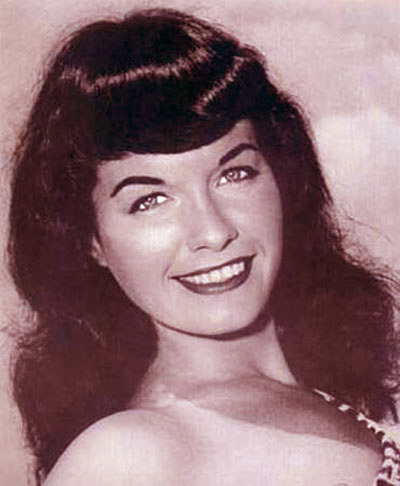
In that post, we observed that Stevens's fame will be forever entwined with that of 1950s pinup queen Bettie Page, whom Stevens used as the prototype for the Rocketeer's girlfriend Betty (note the different yet referential spelling). Stevens's work revived interest in the largely forgotten cult star, returning her to the spotlight after decades of anonymity.

Now, sadly, Stevens's muse has followed him into the next life.

Bettie Page

Bettie Page suffered a heart attack last week, leaving her comatose in a Los Angeles hospital. After having been kept on life support for several days, she passed away earlier today.

Ms. Page made her fame as one of the first models to transition from the underground pornography scene of the '50s into something approaching mainstream media. She was one of Playboy's earliest centerfolds, appearing in the January 1955 issue (one month before actress Jayne Mansfield).

Prior to her debut in Hugh Hefner's bunny rag, Bettie appeared in hundreds of ribald magazines, postcards, and non-explicit short films, many with sadomasochistic or bondage themes. She also posed for a series of pictures by Bunny Yeager, one of the first female pinup photographers. It was Yeager who brought Bettie to Hefner's attention. Thanks to her increased exposure (no pun intended), Bettie rapidly became the most popular pinup model in America.

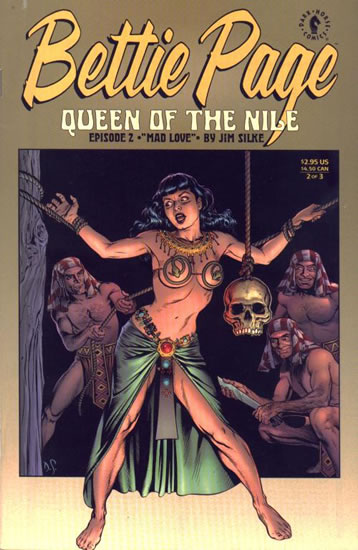
In the late '50s, after her mentor Irving Klaw was prosecuted for distributing pornography through the mail, Bettie underwent a religious conversion and retired from modeling. She later attended several Bible colleges, and reportedly did some charitable and missionary work. She remained in relative seclusion until Dave Stevens, and other artists including Greg Theakston and Jim Silke, introduced the sunny-faced brunette to a new legion of fans. A 2005 film biography, The Notorious Bettie Page, featured Gretchen Mol in the title role.


It's unfortunate that when many people think of Bettie Page, their minds will automatically snap to the word "pornography." Unlike the porn stars of today, Bettie never performed sexual acts of any kind in front of a camera — unless one considers nudity itself a sexual act. Ironically, I first became aware of Ms. Page's career when, as a broadcast journalism student at San Francisco State University in the early 1980s, I wrote a research paper on the adult film industry.

Despite this connection, I, like many of her modern-day fans, really developed an interest in Bettie only after her image began to appear in Rocketeer comic books. My comic art collection contains — at least, so far — only one Bettie-inspired drawing: this Common Elements piece by Greg LaRocque, starring Phantom Lady and the Phantom Stranger. You'll notice that Greg's depiction of Phantom Lady bears a striking resemblance to a certain dark-tressed pinup idol.


Bettie Page declined most requests from photographers in her waning years. She preferred to be remembered as she was in her heyday.

I don't think there's any question but that she will be.

Labels: , ,

Thursday, November 20, 2008

Six degrees of me

Yesterday, I was reading the obituaries on the local newspaper's Web site. (I check the funeral notices frequently, just to be sure I'm not listed in them.) Included was mention of the passing of a man whom I did not know personally, but whose younger sister and I were in the same high school graduating class 30 years ago.

When I pointed this out to my wife, KJ told me that this man's sister-in-law works in her office.

My daughter KM, hearing our conversation, observed that the man's son is her classmate at the junior college.

What are the odds that one random individual whom none of us ever met would have a different line of direct connection to each member of my family?

Four centuries ago — give or take a decade or so — John Donne wrote:
No man is an island, entire of itself;
Every man is a piece of the continent, a part of the main.
If a clod be washed away by the sea, Europe is the less,
As well as if promontory were,
As well as if a manor of thy friend's or of thine own were.
Any man's death diminishes me,
Because I am involved in mankind;
And therefore never send to know for whom the bell tolls;
It tolls for thee.
Or, as Uncle Walt told us so many times...

It's a small world after all.

Labels: , , , ,

Tuesday, November 18, 2008

Drinking the Kool-Aid

Thirty years ago today, a madman named Jim Jones led 909 of his disciples — known collectively as the Peoples Temple — to mass suicide in Jonestown, Guyana. Nearly 300 of the dead were children.

The method of self-destruction chosen by the brainwashed masses (though not Jones himself, who put himself out of the world's misery with a bullet to the brain) lent an enduring new metaphor to the American vernacular: "Drinking the Kool-Aid."

Ironically, it wasn't Kool-Aid, but instead a similar powdered drink called Flavor-Aid, that delivered the fatal cyanide.

History makes mistakes like that sometimes.

The day before the mass suicide, Jones's personal security force, the self-styled Red Brigade, murdered U.S. Congressman Leo J. Ryan, two NBC News staff members, a photographer from the San Francisco Examiner, and a Peoples Temple member on the airstrip at Port Kaituma, Guyana. Ryan, representing California's 11th District, had led a delegation of journalists to Jonestown to investigate allegations of abuse within the Peoples Temple, whose followers had relocated from the Bay Area to Guyana in the summer of 1977. As Ryan and his party attempted to flee with 15 Peoples Temple defectors, the Red Brigade opened fire.

Ryan's assistant, 28-year-old Jackie Speier, survived the attack, along with about a dozen other members of the delegation. Speier suffered five gunshot wounds, including shattered bones in her right arm and leg. Today, Speier represents California's 12th District in Congress.

Jonestown was the biggest news story in the Bay Area since the 1906 earthquake — until ten days later, when Dan White, a former member of the San Francisco Board of Supervisors, assassinated Mayor George Moscone and Supervisor Harvey Milk in their offices at San Francisco City Hall.

I remember the events of what came to be known as the Jonestown massacre vividly. Because my family was both black and religious (the largest proportion of Peoples Temple members were African-American), relatives from all over the country called our house on the day the news broke, fearing that somehow we had been involved in the tragedy. Clearly, we were not.

909 other people — plus Leo Ryan and the four who died alongside him — were.

Until the terrorist attacks of September 11, 2001, the deaths at Jonestown represented the largest single-event loss of American lives resulting from human causes.

Three decades later, the massacre remains burned with laser-like intensity into the memories of those of us who lived in the Bay Area at the time. Jonestown stands as a permanent reminder of the seductive nature of power, as well as the dangers of blind faith.

At least the Kool-Aid company recovered.

Labels: , , , , ,

Tuesday, October 21, 2008

Dolemite has left the scene

By way of my friend The Real Sam Johnson — the undisputed king of bloggers in Savannah, GA — comes the sad news of the death of comedian, actor, and entertainment personality Rudy Ray Moore.

That name might not trip any bells for those of you too young to have experienced the swinging '70s, but readers of a certain age (and those, to be frank, who have the complexion to make the connection) will recall Moore, first as one of the premier purveyors of what we called "party records" back in the day, and then as the lead in several blaxploitation flicks, most notably playing the outrageous pimp-slash-action hero known as Dolemite.


Moore was, first and foremost, a stand-up comic and raconteur who worked the so-called "chitlin circuit" in the 1960s. Like many African-American comics of that era, he produced inexpensive record albums featuring his down-and-dirty, profanity-and-graphic-sexuality-laden routines, targeted specifically at black audiences. (Although I've been surprised over the years to discover how many of my Caucasian acquaintances also grew up listening — mostly in secret — to these "party records," so dubbed because people often played them as entertainment at adult gatherings.) Richard Pryor, Redd Foxx, Pigmeat Markham, and ventriloquist Willie Tyler were among the leading practitioners of the genre.

As the blaxploitation boom was sweeping the film industry, propelled by such hit movies as Shaft and Superfly, Moore began looking for a way to cash in. His ticket into cinematic legend was Dolemite, a character that had long been a feature of Moore's stand-up act.

The on-screen Dolemite was a flamboyant cross between every stereotypical cliché about urban pimps and a hard-charging street fighter of the kind then being portrayed by Jim Kelly, Fred "The Hammer" Williamson, and other blaxploitation stars. (Think Huggy Bear, with an R-rated vocabulary.) When the 1975 film Dolemite became a cult hit, Moore reprised the character in The Human Tornado the following year. In 1978, Moore unleashed his other signature character, Petey Wheatstraw, the devil's son-in-law. (I kid you not.)

Moore's movies, made on budgets that you could probably scrape together from loose change you found beneath your sofa cushions, were not high cinematic art. Indeed, it's fair to say they're the kind of flicks that Ed Wood might have made if he had been a black comic in the 1970s. But the films connected with their intended audience, so enduringly that Moore and his Dolemite persona evolved into hip-hop icons, appearing on several popular rap recordings and in numerous videos.

They definitely don't make 'em like Rudy Ray any Moore.

Labels: , , ,

Friday, October 17, 2008

Comic Art Friday? I can't help myself

Today's Comic Art Friday is dedicated to the memory of Levi Stubbs, lead vocalist of Rock and Roll Hall of Fame members, the Four Tops.

Stubbs, whose inimitable baritone propelled such tracks as "Baby, I Need Your Loving," "I Can't Help Myself (Sugar Pie, Honey Bunch)," "Reach Out, I'll Be There", "It's the Same Old Song," and my all-time favorite Tops classic, "Standing in the Shadows of Love," died earlier today after nearly a decade of failing health. He was 72.

In addition to his contributions to American popular music, Stubbs will be remembered by film fanatics as the voice of Audrey II, the anthropomorphic man-eating plant in the musical version of Little Shop of Horrors. If you were going to hire someone to belt out a tune entitled "I'm a Mean Green Mother From Outer Space," I can't think of anyone better than the bombastic Stubbs. Neither, apparently, could the producers of the movie.

Speaking of bombastic, here's a recent entry in my "Bombshells!" commission series. The beauty playing "Peek-A-Boo!" with danger is Miss Masque. The talent behind the pencil is pinup artist Anthony Carpenter.


Miss Masque debuted in Exciting Comics #51, published in September 1946 by Nedor Comics (later known as Standard Comics). Nedor, which started out in the pulp magazine field before branching into comics, was the brainchild of entrepreneur Ned Pines, who also founded the paperback original book imprint Popular Library. If you read genre fiction extensively anytime between the 1940s and the early 1980s, you probably perused some Popular Library titles.

Back to Miss Masque: Vivacious socialite Diana Adams donned a short, bright red dress, a rakish fedora, and a black domino mask (hence her code name — I guess 1946 was a mite early to call herself "Miss Miniskirt") to battle evildoers. With no superpowers to call upon, Miss Masque relied upon good old-fashioned firepower in the form of twin .45s to dispatch the bad guys.

During her three-year run, Miss Masque proved to be one of Nedor's more popular characters, making frequent cover appearances in artworks by such luminaries as Frank Frazetta and Alex Schomburg. Her enduring popularity has resulted in several revivals in recent years, most notably in AC Comics' Femforce, America's Best Comics' Tom Strong and Terra Obscura, and the current Project Superpowers series, created by writer Jim Kreuger and artist Alex Ross for Dynamite Entertainment. (She's known as "Masquerade" in the latter book.)

Artist Anthony Carpenter is one of the most unique stylists represented in my collection. Anthony's deft tonal pencil technique creates a spectacular sense of warmth and depth, and his whimsical, nostalgic sensibility made him an ideal choice to add to my "Bombshells!" series.

In addition to retro-flavored pinup art, often with a kitschy-cool "tiki" or "jungle girl" theme, Anthony specializes in pastiches of 1960s genre film posters. His creations in each of these areas embodies a singular, charming imagination unlike any other artist working today. If you like Anthony's stuff, I recommend a tour of his Comic Art Fans gallery or his Sketchville! blog.

I think even Levi Stubbs would have enjoyed Anthony's first contribution to my Common Elements commission series, in which Alan Scott, the original Green Lantern, and Saturn Girl from the Legion of Super-Heroes find themselves facing a "mean, green mother from outer space." Could this be a cousin of Audrey II?


Time to reminisce with a few Four Tops sides. You might consider doing likewise, if you have any soul.

And that's your Comic Art Friday.

Labels: , , ,

Thursday, October 16, 2008

Kingpin

This won't elicit much play beyond my immediate vicinity, but what the hey... I can be provincial when I choose to be.

The man who built much of my town died today.

Jimmie Rogers was an up-and-coming real estate salesman back in the early 1960s when he persuaded the namesake family on whose one-time seed farm the city of Rohnert Park now stands to hire him as their representative. Rogers parlayed that position — and a legendary silver tongue — into a lucrative political and development career.

Rogers's talent for negotiation led to the creation of most of the residential tracts in town, including the one where I live. He was also responsible for the local community center, golf course, numerous commercial projects, and a host of parks and schools. Rogers served for nearly a decade on the city council, and when his development connections drove him out of the political arena, he continued to control the council through his proxies for decades afterward.

Having lived in Rohnert Park for most of the past 30 years, I've heard plenty of stories about Jimmie Rogers, although I met him in person only once, when I was still in high school. I don't know how many of the stories are 100% true.

Without question, Rogers cut a colorful figure around town. He liked to dress like an extra from Urban Cowboy. His hands wormed their way into plenty of pockets and his fingers probed a lot of pies. Where there were palms to be greased, Rogers was the one who gave and got the grease. Where deals were being hammered out in smoke-filled back rooms, Rogers did most of the puffing.

Rogers was frequently accused of playing fast and loose with the legalities of city business, to the point that the FBI took a hard look at him on at least one occasion. But he had as many fans as he had detractors — a friend of mine in the real estate business can't say enough good about the guy.

This much I do know...

If it weren't for Jimmie Rogers, this would be a very different community. And I wouldn't be typing under this roof.

Labels: , , ,

Saturday, September 27, 2008

Behind blue eyes

I awakened this morning to the sad news that Paul Newman had passed away.

Almost immediately, I began thinking about my favorite Newman films. After considerable dithering, I narrowed the list to a baker's half-dozen.

1. The Sting. An easy selection, as it's one of my ten favorite films of all time. Newman is perfect as dissolute con artist Henry Gondorff, who teams up with tyro Johnny Hooker (about a decade too old for his youthful role) for one last big score. The scene in which a faux-drunk Gondorff fleeces mobster Doyle Lonegan (Robert Shaw) at the poker table is a classic.

2. Cool Hand Luke. One of the films of the 1960s that pioneered the antihero archetype that would become ubiquitous in the following decade. Newman's free-spirited convict with a knack for escape defined a generation of maverick leading men.

3. The Hustler / The Color of Money. Made 25 years apart, these two films chronicle the early and late stages in the career of a small-time pool shark. As "Fast Eddie" Felson, Newman compelled audiences to rethink their concept of the traditional sports hero. The return of an older, more settled, and mostly wiser Eddie won Newman his only Academy Award for acting. (He won a career retrospective Oscar in 1986, and the Jean Hersholt Humanitarian Award in 1994.)

4. The Verdict. Paul Newman speaking David Mamet dialogue — what could be better? Although I rate the preceding films more highly overall, Newman's portrayal of a morally conflicted boozehound attorney is, in my opinion, the finest performance of his career. Ironically, Mamet wrote the lead role for Newman's friend and collaborator Robert Redford, who ultimately turned the part down.

5. Harper / The Drowning Pool. This pair of detective dramas are more sentimental choices than anything else. I was an avid reader of Ross Macdonald's Lew Archer novels when I was in high school, so I never missed an opportunity to catch either of these films — based on Macdonald books, albeit with the protagonist's surname changed to reflect Newman's success in films whose titles began with "H" (i.e., The Hustler, Hud, Hombre).

6. Torn Curtain. Neither Newman nor director Alfred Hitchcock liked the way this Cold War suspense thriller turned out. I personally think it's one of Hitch's better late-period films, and Newman gives an interesting, somewhat atypical performance opposite Julie Andrews.

Yes, I know — you were waiting for Butch Cassidy and the Sundance Kid. Funny thing: As much as I love The Sting, I'm not a real fan of Newman, Redford, and director George Roy Hill's earlier team-up. My preferences in '60s Westerns run toward Sergio Leone — thus, like Roger Ebert, I find Butch and Sundance too flimsy and lightweight for my taste.

In addition to being a consummate actor, Paul Newman made his mark on the world as a philanthropist, entrepreneur, sportsman, and political and social activist. He and his wife, fellow Academy Award winner Joanne Woodward, celebrated their 50th wedding anniversary in January of this year — an accomplishment as noteworthy as any in Newman's amazingly full life.

The world will be dimmer without Newman's crystal blue gaze.

Labels: , , , ,

Wednesday, September 24, 2008

Cry, the beloved Sony

Our living room television set — the imposing 35-inch Trinitron that my good friends at Jeopardy! included in my Battle of the Bay Area Brains prize package ten years ago — has given up the ghost.

It will be replaced for the nonce by its predecessor, a 32-inch Fisher that has seen little use in the decade since it retired to the master bedroom.

The Trinitron is survived by its loving siblings — a DVD player and surround-sound system that arrived along with it. It was preceded in death by its longtime companion, a Sony VAIO notebook computer.

Memorial services are pending.

Labels: , ,